Press
Argentina’s ‘Madman’: Inside the world of Javier Milei
Images
1 / 20
2 / 20
3 / 20
4 / 20

5 / 20

6 / 20

7 / 20

8 / 20

9 / 20

10 / 20

11 / 20

12 / 20

13 / 20

14 / 20

15 / 20

16 / 20

17 / 20

18 / 20

19 / 20

20 / 20
Argentina’s ‘Madman’: Inside the world of Javier Milei

Save

Share

Otacon Party, a regular event for anime and manga fans held at the Galicia Centre in Buenos Aires, has never been known for being overtly political. Attendees buy comic books and Pikachu plushies, and sing karaoke, often dressed in colourful costumes.

But at the February 2019 event, one cosplayer stood out among the rest.

“I am General Ancap,” declared the masked figure in a black-and-yellow superhero outfit, wielding a giant sceptre.

“My mission is to kick the asses of the Keynesian and collectivist sons-of-bitches who want to screw up our lives.”

While most superheroes are content enough fighting mutants or evil geniuses with doomsday devices, General Ancap (short for anarcho-capitalism) – or to use his true identity, the radical economist Javier Milei – considered the government itself a criminal enterprise.

Four years later, General Ancap became the president of Argentina.

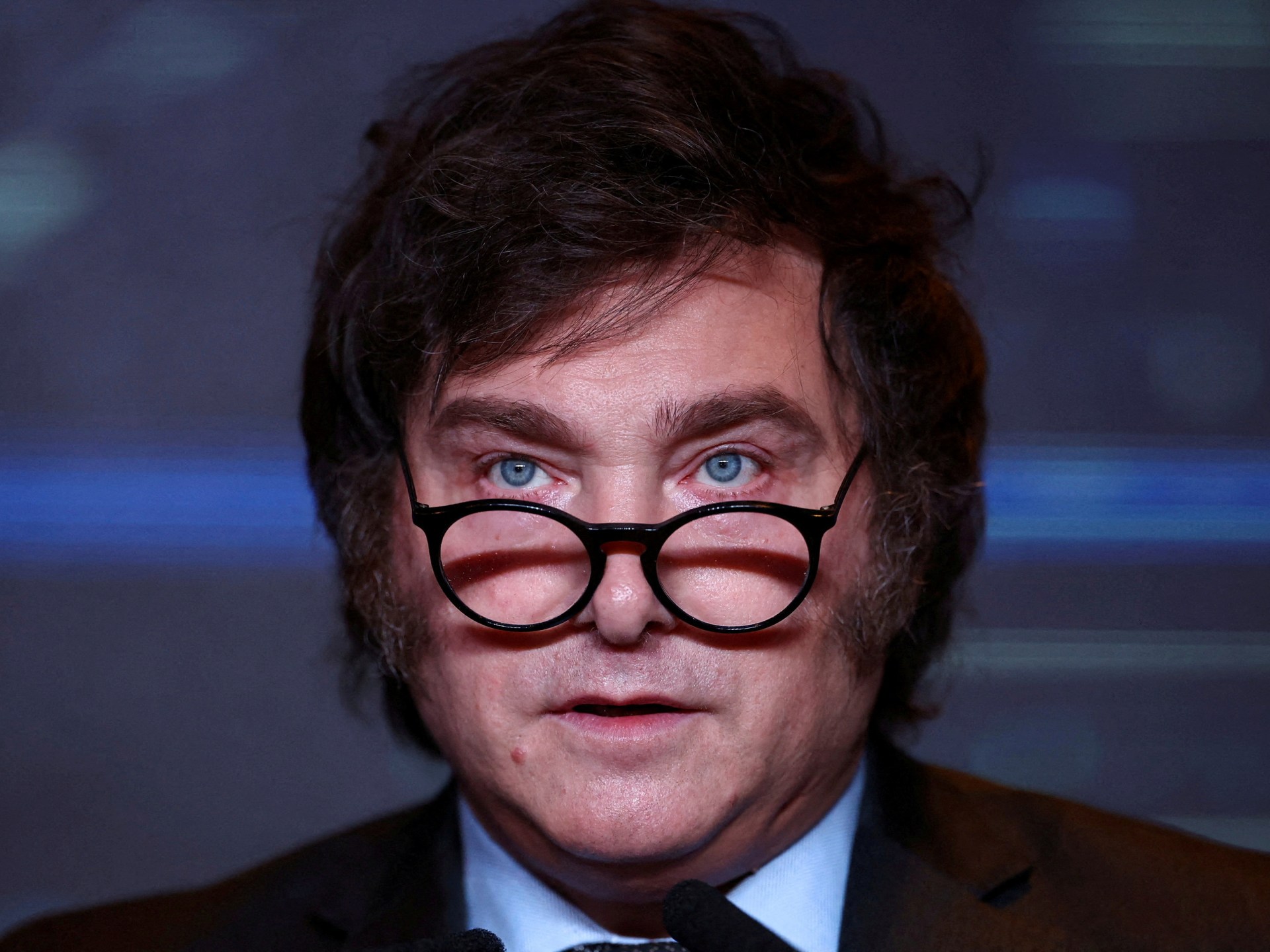
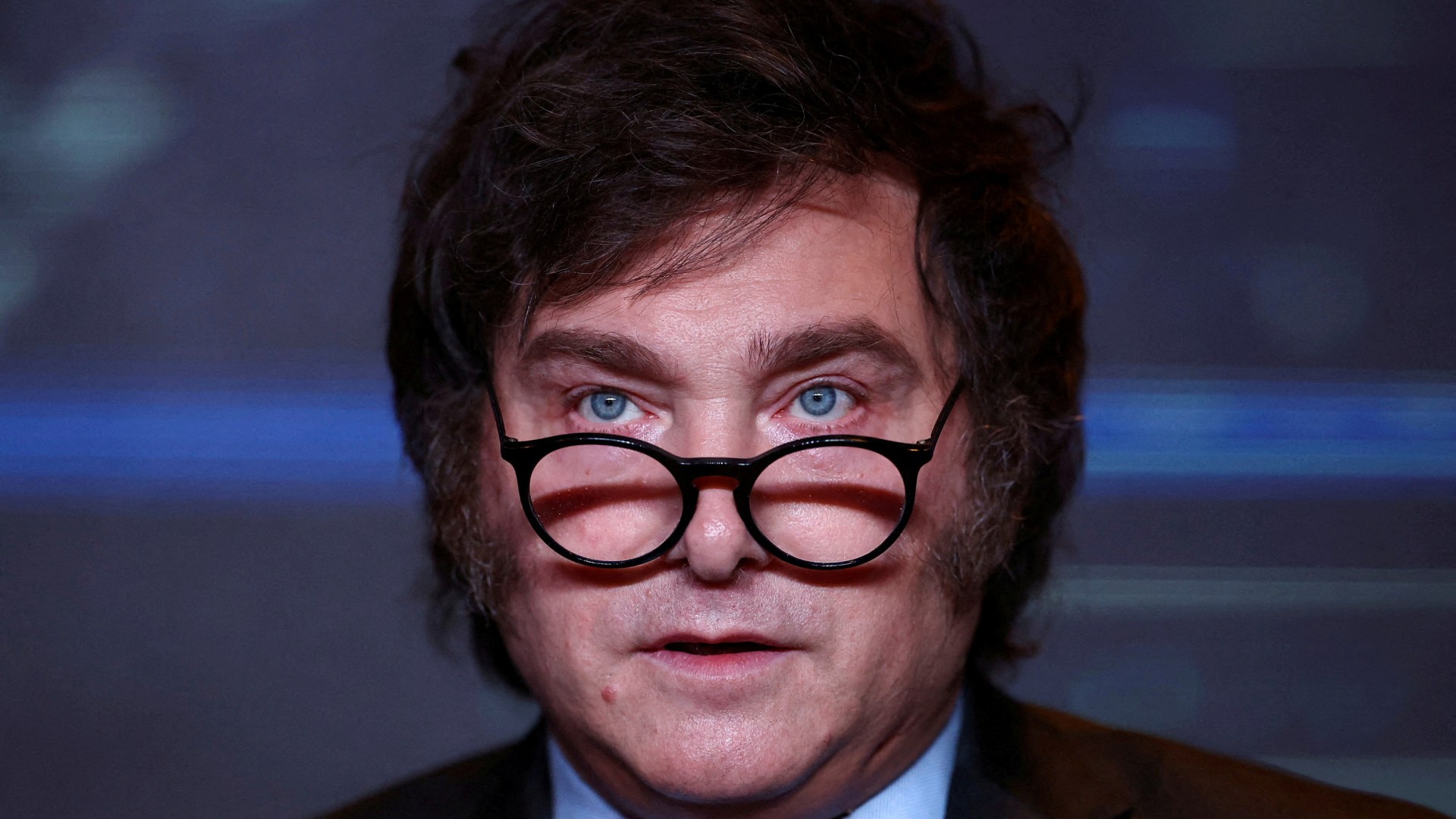
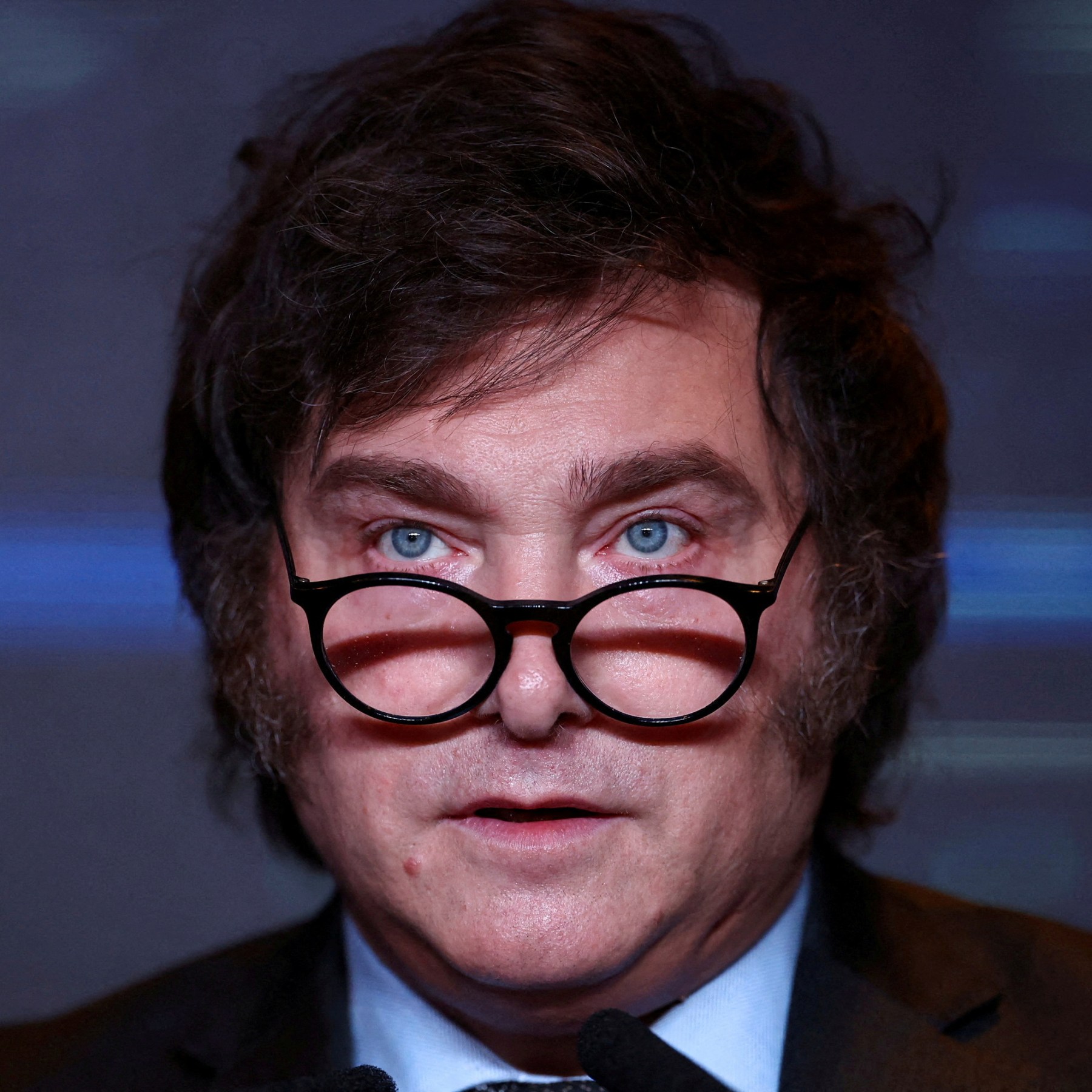
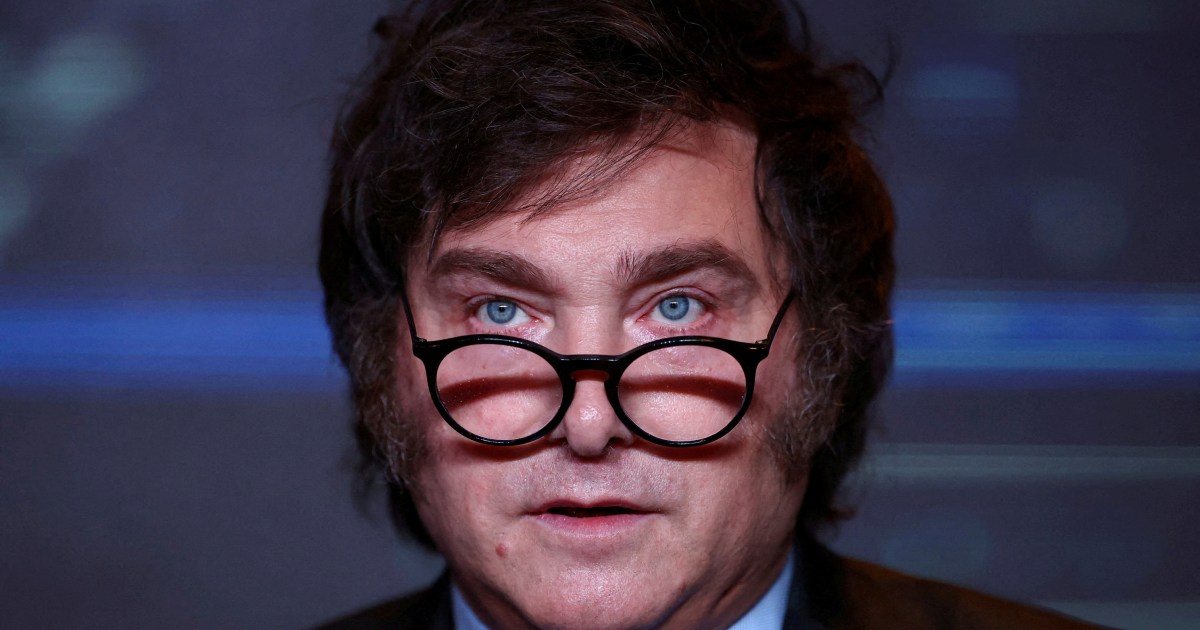
Milei tends to be theatrical, and his public appearance – signature lambchop sideburns and wild hair – is no less iconic than that of his superhero alter-ego. The larger-than-life pundit-turned-president has a reputation for being eccentric, from swinging a chainsaw around at rallies to telepathically talking to his deceased dogs.

“All of us who know him know that he is not a balanced person,” Mariano Fernández, an economist at the University of CEMA (UCEMA) in Buenos Aires, told Al Jazeera. Fernández knew the president from their time together in academia in 2005 until Milei entered politics around 2020.

“His relationship with power, his exercise of power, his vehemence and his mood swings are what represent what the government of Milei is,” he said. “Essentially, it is an autocratic, anarchic and paranoid government.”

Elected on a pledge to revive the South American nation’s crisis-stricken economy through “shock therapy” – a controversial strategy involving deregulating businesses and drastically slashing government funding – Milei’s agenda has had mixed results.

Corruption scandals have also dogged his administration. Last year, Milei’s sister, Karina, his closest confidant, was implicated in a kickback scheme involving foreign pharmaceutical firms.

So, what goes on in the mind of the world leader, nicknamed “El Loco” – the “Madman”?

Javier Gerardo Milei was born on October 2, 1970, in Buenos Aires. His father, Norberto, was a taxi driver and, eventually, the owner of a transport company. Norberto was also abusive, often beating little Javier, calling him “trash” and telling him he would die of hunger.

“He was attacked and humiliated by his father; he had a really, really difficult life, and the Milei we see now is obviously a consequence of that,” Juan Luis González, author of "El Loco," a biography of the Argentinian leader, told Al Jazeera.

Only Karina tried to protect him, while Milei’s mother, Alicia, a housewife, was not violent but enabled the abuse by siding with her husband. Once, Karina witnessed Norberto beating her brother so severely that she suffered a panic attack.

“Your sister is like this because of you,” Alicia had told her son. “If she dies, it’s your fault.”

While he would later distance himself from his parents, even refusing to speak with them, Karina remained one of his closest confidants.

At this time, from 1976 until 1983, Argentina was under military rule, following a coup d’etat set on exterminating so-called "terrorists". Death squads murdered up to 30,000 suspected communist sympathisers during the Dirty War, and many more were tortured. Military rule ended shortly after Britain’s victory in the 1982 Falklands War – fought over contested islands 500km (300 miles) east of Argentina in the South Atlantic – and democracy returned with elections the following year.

As a teenager, Milei sang in a Rolling Stones tribute band and had a brief spell as a semi-professional footballer, playing goalie for the Chacarita Juniors, where he was nicknamed “El Loco” for his fiery temperament.

“He wasn’t afraid of anything,” a teammate recalled to the newspaper La Nacion.

“We trained on fields that were really rough. Rain or shine, we practised anyway. Nothing mattered. And he would do things that made us wonder… why does he do them?”

But young Milei’s interests soon pivoted to economics; he enrolled in university and earned two Master’s degrees. While in graduate school in the 1990s, Milei came across the work of early 20th-century British economist John Maynard Keynes.

Observing how unrestrained capitalism had led to the Great Depression of the 1930s, Keynes argued that governments should intervene to create jobs, offset inflation through taxes, and stimulate the economy during recessions with reduced interest rates. Keynesian ideas, notably, were behind the strong welfare states that emerged in Europe after World War II.

Milei was not a fan of Keynes. The Argentinian was much more attracted to libertarian economists, especially Friedrich Hayek and Milton Friedman. Hayek argued against state intervention, believing it clashed with personal freedom and private property, while Friedman’s star pupils, the so-called "Chicago Boys", advised Chilean dictator Augusto Pinochet. Their ideology, known as neoliberalism, was the inspiration for Ronald Reagan and Margaret Thatcher. Milei once described the United Kingdom's first female prime minister as “one of the great leaders of humanity".

That reverence is not just rhetorical; it reflects Milei’s deep ideological conviction about the market’s role.

“This is precisely what distinguishes Milei from conventional liberalism,” political scientist Juan Bautista Lucca of the National Scientific and Technical Research Council (CONICET) told Al Jazeera.

“For him, the market is not simply efficient; it’s just. This is a moral question.”

Another inspiration was Murray Rothbard, the father of anarcho-capitalism.

Rothbard rejected any form of state authority, believing that taxes and welfare should be abolished. Instead, society should be organised purely around private contracts.

“There would be no monopoly of violence, no state taking the law in its own hands that decides all conflicts,” explained German economist Phillip Bagus, author of the book The Milei Era and a supporter of the president.

“Everything would be private. There would be private streets, private hospitals, schools, universities, healthcare, police. Everything would be based on voluntary cooperation.”

In a 2024 interview with The Economist, Milei revealed that it was reading Rothbard’s books in 2013 that converted him to anarcho-capitalism. However, Milei recognises the difficulties of putting these ideas into practice and considers himself a minarchist: one who slims government duties to purely provide security (law enforcement and defence).

“He is a great communicator of ideas, but his theoretical knowledge is quite weak, contradictory, and dogmatic,” opined Fernández, who first met Milei in 2005 after reviewing and offering feedback on one of his academic papers.

In 2016, Milei made his first television appearance at age 45 on the late-night talk show Loose Animals, where he was asked about Keynes. Milei flew into a rage, ripping into not only socialists but the then-conservative government of Mauricio Macri. From then on, Milei became a regular fixture on Argentinian television, railing against the inefficiencies of government and denouncing what he described as the corrupt ruling “caste” of politicians, journalists, trade unionists and academics.

“The state is the paedophile in the kindergarten, with the children chained up and slathered in Vaseline,” he said on a 2018 television show, equating the state to a predator.

Many of Milei’s early televised appearances were on the channels A24 and América TV, owned by billionaire airport magnate Eduardo Eurnekian. Milei worked for Eurnekian from 2008 until 2021, ultimately becoming the chief economist at the tycoon’s Corporación América.

According to Lucca, Milei’s media spotlight was the deliberate result of a “metapolitical strategy” by these powerful interests:  “The idea of the battle for cultural hegemony conducted not through [political] party structure but through the media arena and social networks."

“That's why I say from the beginning, he doesn't follow the classic path of party insider or traditional outsider. He's an untraditional outsider," Lucca said.

Milei’s rhetoric towards those he perceived as the enemies of freedom was openly hostile.

“You can’t give leftist turds an inch,” he professed in a television interview that aired in October 2023.

“If you think differently from them, they will kill you. This is the point. You can’t give leftist turds an inch. If you give them an inch, they will use it to destroy you.”

“[This] distinguishes him from the rest of the politicians in Argentina – the Milei you see is the Milei there is,” said González.

“There is no character that he’s playing. He was really, really angry, and in that moment, his anger, his way of insulting all [his opponents] … he fit with the anger that a lot of people in Argentina had with the pandemic, with the economic crisis, with the inflation, or the bad government we had before. Milei was the right man at the right time."

In 2021, Milei was elected to Congress, initially as a member of a libertarian coalition, but soon founded his own party, La Libertad Avanza (Liberty Advances). As a congressman, Milei theatrically declared that his salary was “money stolen from the people by the state", and that he would give it away in a monthly raffle broadcast on national television. Within hours of his announcement, 250,000 Argentinians had signed up.

Milei lived up to his promise, giving away his congressional salary each month.

The following year, he announced his run for president.

During his 2023 presidential campaign, Milei described early 20th-century Argentina as “the richest nation on earth”, thanks to its vast beef and grain exports being carried by steamships to every corner of the globe. But by the turn of the new millennium, the economy was taking a beating.

There were multiple reasons for Argentina’s financial woes, but most of all, Milei blamed Peronism. Juan Domingo Perón was an Argentinian army colonel who first took power in a 1943 military coup, becoming so popular with the labour unions that, when he was overthrown and jailed two years later, a mass movement rallied behind him. He was released and ran for president the next year, winning more than half of the vote. Perón was forced into exile in 1955, but returned in 1973 to be re-elected as president, only to die a year later, leaving behind his ideology: Peronism.

Although Perón had been inspired by fascist Italy, Peronism’s defining feature was to make Argentina one of the world’s largest welfare states, which Peronist governments financed by simply printing more money. Inflation became a part of everyday life in Argentina. Between 2000 and 2021, the country had defaulted on its national debt three times. By the early 2020s, two-in-five Argentines were living in poverty.

“The country was run down through Peronism,” said Bagus, the economist.

“Totally uncompetitive. Protectionism. Basically, nothing could be imported. And there was huge corruption," he explained. "A political establishment together with entrepreneurs that work close to politics, and labour unions and media, all working together to enrich themselves from hard-working Argentinians. Totally over-regulated. The labour market totally dysfunctional. A currency that was basically worthless. No credibility in the government...”

“It was a total mess,” he added.

In 2003, Peronist President Néstor Kirchner was elected to office, followed by his wife, Cristina Fernández de Kirchner, for two more terms. Between 2015 and 2019, voters gave the centre-right businessman Mauricio Macri a chance to run things differently, but he, too, failed to revitalise the economy, so Cristina Kirchner returned as vice president to Alberto Fernández, another Peronist.

By the time of the COVID pandemic, the public had lost faith in the established political parties, and a deep schism began forming in Argentinian society, according to Lucca.

“This is what analysts have called ‘la grieta’ in Spanish – a cleavage, or deep social and political trench that exhausts citizens on both sides,” he explained.

To the younger generation, half of whom were living in poverty, the “Madman” looked like a saviour who would make government cuts.

In a campaign stunt in August 2023, Milei stood next to a bulletin board with the names of government ministries, ripping them off one by one, and yelling “Afuera!” – “Out!”

A month later, a crowd chanted “Chainsaw! Chainsaw!” at a rally in La Plata, a short drive southeast of Buenos Aires, as Milei took to the stage in a black leather jacket, waving the roaring power tool. The chainsaw – a metaphor for decimating the bloated government – became a symbol of his campaign.

Milei’s campaign slogan was no less assertive: “Viva la libertad, carajo!” – “Long live liberty, dammit!”

Milei won support among many quarters of Argentinian society who were sick of the status quo by rallying against the entrenched political and economic elite, which he referred to as the “caste”.

“A lot of people in Argentina said, ‘He is angry, like me,’” explained González.

“A phrase I heard a lot in those times is, ‘We need a man to fix this country.’”

In October 2023, Milei won 57 percent of the vote against his opponent, former Finance Minister Sergio Massa. At his inauguration, a crowd of supporters stood before Congress wearing hats that read “MAKE ARGENTINA GREAT AGAIN” – a play on US President Donald Trump’s political slogan – with one holding a giant cardboard cutout of a chainsaw.

“Cristina is going to jail!” they chanted when Cristina Kirchner appeared alongside Milei to symbolise the transition of power. Kirchner responded with her middle finger.

After the ceremony, Milei joined his sister, Karina, onstage and gave a lecture on the economic ailments plaguing the nation. After 40 minutes of economist jargon, the crowd seemed to be getting restless, until Milei ended his speech with, “...a country where the state doesn’t run our lives”. At that, the audience burst into chants of “Chainsaw!”

As promised, Milei took a chainsaw to the budget, closing 10 out of 19 government ministries by executive decree as soon as he stepped into office. Between late 2023 and 2025, social spending was slashed by 17 percent, while environmental programmes were completely gutted, according to an analysis by the Bretton Woods Project. Milei has espoused climate crisis denialism, promoting the idea that global warming is part of a natural cycle unrelated to human activity.

At the same time, consistent with Milei’s beliefs that the state should provide protection, the security budget was vastly inflated.

Milei’s radical reforms succeeded in slowing hyperinflation, reducing it from 211 percent in 2023 to 31.5 percent by late 2025, according to official figures. However, this has come at a huge social cost. Workers’ rights have been eliminated, and more than 110,000 Argentinians with disabilities have lost their benefits. While the official poverty rate has nearly halved since 2024, critics say the data is skewed by the shutdowns of organisations that collect this data. At the same time, official data shows that homelessness has risen by about 57 percent in Buenos Aires, the richest city in the country.

On the outskirts of the capital lie the villas miseria, deprived shantytowns sometimes lacking even the essentials, such as electricity and running water. There, drug cartels have stepped in to fill the state’s absence, funding soup kitchens that would otherwise have closed under Milei’s austerity measures. The gangs have become increasingly brazen, as illustrated by last year’s livestreamed triple murder of three young women for stealing a parcel of cocaine.

Discontent with Milei has grown since 2023, with thousands of citizens from all walks of society repeatedly taking to the streets of Buenos Aires for anti-austerity protests, banging pots and pans outside the neoclassical facade of the National Congress. Pensioners demonstrating against cutbacks that push them below the poverty line have been beaten with batons, while students have rallied against Milei’s cuts to Argentina’s prized tuition-free university system.

Besides downsizing the state, Milei has promised to dollarise the economy. If the US dollar became the national currency, he reasoned, the government could not resort to printing more money. However, he has shied away from putting this into practice, blaming the realities of Argentina’s political system for holding him back.

These realities of running a country without a majority in Congress have meant Milei has had to compromise. To pass his radical reforms, Milei has negotiated with both the Peronist opposition and the conservative party of former President Macri.

“Even if his party and the conservative party pull together, they don’t have 50 percent of seats [in parliament],” said Bagus.

“So, for any law to pass, they still need moderate Peronists to approve a labour market reform [in 2026].”

These compromises have disappointed some fellow libertarians, who accuse Milei of selling out his vision.

Still, Bagus sees it as a step in the right direction.

“Of course, libertarians want more. I would have wanted to have even more flexibilization of the labour market,” he said. “But it’s the first such reform in Argentina for 50 years… It’s fair to criticise him and say, please, go faster, but he’s always said that the restrictions for doing politics are much, much bigger than he thought before he went to his position.”

After his 2023 election win, Milei took to the stage to dedicate his victory to those closest to him.

“Who else? My four-legged children,” he said.

Milei owns a pack of English mastiffs, named Murray, Milton, Robert and Lucas, after his favourite economists: Murray Rothbard, Milton Friedman, and Robert Lucas. They are all clones created from the DNA of Milei’s original dog, Conan (short for Conan the Barbarian). In his book, González wrote that when Conan died in 2017, Milei was unable to accept his death and visited a medium to communicate with the dead pup telepathically. In their conversations, Conan reportedly revealed that they had met in a past life as fighters in a Roman gladiator arena 2,000 years ago, and he told Milei to run for president.

“Is it true that you have telepathic conversations with Conan?” asked an El Pais reporter.

“Sure, and they also say that my dogs are my advisers, and they are fabulous, because look at everything I’ve achieved in terms of results,” Milei replied.

“But then you do talk to Conan?” the reporter pressed.

“What I do inside my home is my problem,” the president answered.

A fifth hound, also named Conan, the president reportedly believes to be a reincarnation of the original. Milei’s relationships with his dogs, both living and dead, have fuelled concern about his mental health.

Another important figure in his life is Karina, whom he describes as “the most marvellous being that exists in the universe".

“The only person besides him throughout his life was Karina,” said González.

“Javier Milei was never a functional human: He didn't have a kitchen in his house, he didn't know how to pay taxes, he didn't know how to cook, he didn't know how to buy clothes. All those things Karina did for him.”

As an adult, Karina gave tarot card readings. It was Karina, in fact, who trained in the art of the occult to communicate with Conan and comfort her grieving brother.

“Karina is the female version of Milei,” said Fernández.

“They are people with serious psychological problems, and therefore, paranoia – magical and mystical thinking taking precedence over any rational thought. Karina has the same problems as Javier. Before they entered politics, Karina used to talk to animals, and the animals would answer her.”

Later, Milei appointed her as head of his presidential campaign, handling his bank account and expenses and personally bringing him Monster energy drinks before rallies. After the election, Milei appointed Karina as the presidential chief of staff, and while she largely stays out of the limelight, his sister is arguably the second-most powerful person in Argentina.

“The first time when I met him in October 2022, he said, ‘Let’s have lunch together,’” Bagus recalled of an event they attended in Madrid.

“So I came to his hotel, and then he said, ‘Well, El Jefe [the boss] is also here. Who’s the boss? My sister.’”

Karina can be even more important than her brother in terms of governance, according to González.

“In Argentina, we say that Javier Milei is the most important person in the government of Karina Milei,” he said.

“It is she who decides who is in and out of the government; who are the people who enter the election to become legislators. Karina decides.”

Insiders told The New York Times that she is uncompromisingly loyal to her brother and effectively a gatekeeper for government business, with the ability to get any official she dislikes fired. By her own admission, one staffer was shown the door for speaking disrespectfully about Conan.

In a televised interview on A24, Milei described their relationship with a biblical analogy.

“Moses was a great leader, right? But he wasn’t a great communicator. And so, God sent him Aaron so he could, let’s say, communicate. Kari is Moses, and I am the one who communicates. Nothing more.”

Friends have described Milei as a bit of a loner and teetotaller who becomes energised as soon as he speaks to a crowd, especially about economics. In private, the Argentinian president told the New Yorker magazine he enjoys movies about mathematicians, like Good Will Hunting, and is still a huge fan of the Rolling Stones, having attended 14 of the 15 concerts they have played in Argentina since the 1990s. He also enjoys opera and is still a singer himself, performing in a rock band to a crowd of 15,000 at a book launch last year.

“I’ve talked to him about music and quickly realised all his knowledge is superficial,” remembered Fernández.

“He says he likes opera, but he doesn’t really know what he likes. His real passion is economics.”

One-on-one, Bagus describes Milei as kind and considerate to his friends.

“When he has contacted me on WhatsApp, he always begins by saying, ‘Dear Phillip, sorry for bothering you, can I have a minute?’ I think this is a very nice way to express it, because the guy is totally busy and everyone wants something from him.”

Though Milei is often described as right-wing, he does not neatly fit the stereotype of a traditional conservative. An open sexual libertine, he has spoken of being a proponent of free love, tantric sex, and enjoying ménage à trois.

Libertarianism prizes personal freedom, and Milei is distinct from other contemporary world leaders on the political right in believing that sex work, drug use, and sexuality are all private matters for consenting adults that the state has no business in.

At the same time, Milei is opposed to abortion, considers sex education “brainwashing”, and views the very idea of social justice as abhorrent. Proudly believing he is waging the culture war on the side of “freedom”, Milei argues that any wealth redistribution is immoral, that benefits make recipients lazy, and that universities are hives of progressive indoctrination.

“Woke is the cancer that must be eradicated,” he told the 2025 World Economic Forum in Davos.

“It has colonised our institutions, our universities, our media, and even our supranational organisations.”

Milei sometimes identifies as a paleo-libertarian – a right-wing libertarian.

“The conservative or right-wing libertarian believes that, for the flourishing of society, there’s necessarily something more than liberty, and those are certain values,” Bagus explained.

“While the left-wing libertarian says, ‘Well, values don’t matter’ – you can be totally hedonist, for instance – the right-wing libertarian thinks that hard work, sacrifice, savings and traditional institutions that have evolved freely in society, like the churches or the family, are very important for society to function well.”

At the same time, Bagus says, Milei is a follower of classical liberalism and respects “the life project of others”, for example, regarding homosexuality. But Milei’s speech in Davos – in which he linked homosexuality to child abuse and called out both the “LGBT agenda” and gender ideology – suggests he may be taking a more conservative, religious turn.

Although he was raised Catholic like most Argentinians, Milei has a long-professed admiration for Judaism and plans to convert. Argentina has Latin America’s largest Jewish community, forming 0.5 percent of the population. During his inauguration speech, Milei invoked the tale of the Maccabees, ancient Jewish warriors, as a “symbol of the victory of the weak over the powerful”. Afterwards, Milei flew to New York to visit the tomb of influential Hasidic spiritual leader Menachem Mendel Schneerson, known as “the Rebbe”, and appointed his personal rabbi, Axel Wahnish, as envoy to Israel.

Milei’s embrace of Judaism both complements and contradicts his ideology. On the one hand, the Argentinian president wholeheartedly supported Israel’s genocidal war on Gaza, and its war on Iran. On the other hand, he rages against “cultural Marxism,” an anti-Semitic conspiracy theory that accuses leftist Jewish intellectuals of undermining Western civilisation.

“Milei is into Judaism, he’s into evangelism, and he’s got a political alliance with ACIERA, an organisation that gathers evangelical churches in Argentina. He has a personal pastor,” said González.

“It’s like a salad of various religions.”

González mentioned that Milei has entertained a 1971 prophecy by Benjamín Parravicini, a psychic nicknamed the “Argentinian Nostradamus”, who foretold 9/11, predicting that a “grey man” would save Argentina. Some of Milei’s most devoted supporters believe that he is the “grey man”, and the president and his sister have hosted Parravicini's great niece at the presidential office.

In recent years, Milei has become more deeply absorbed by the spiritual and mystical world. In April, he visited the Wailing Wall in Jerusalem and gave a speech at Bar-Ilan University, in which he described capitalism as “God’s law”, claiming that Karl “Marx was a satanist”.

“I think the anarcho-capitalist label is just a kind of marketing,” said Fernández.

“I don’t think he understands that he’s not an anarcho-capitalist, either. I think that these libertarian ideas have mutated from the truly anarcho-capitalist position of Ayn Rand into a kind of retrograde conservatism. I would call it a delusional neo-fascism.”

In February 2025, right-wing ideologues gathered at the Conservative Political Action Conference (CPAC) in Washington, DC. Tech billionaire Elon Musk strode onstage wearing sunglasses and a black MAGA hat and informed the crowd that Milei had a gift for him. The Argentinian then appeared and presented Musk with a chainsaw engraved with Milei’s slogan: “Long live liberty, damn it!”

“This is the chainsaw for bureaucracy,” Musk declared.

Milei’s presence at CPAC illustrated how the Argentinian maverick is actively positioning himself in a global coalition of rightist leaders, which also includes Trump, Israeli Prime Minister Benjamin Netanyahu, and Nayib Bukele of El Salvador and Jose Manuel Kast of neighbouring Chile. In March, Milei, Bukele, Kast and other Latin American presidents met in Miami to enlist their countries in the Shield of the Americas, a Trump-led military alliance against criminal gangs.

The so-called “war on drugs” and organised crime, however, seems to take a backseat to other considerations. Late last year, Juan Orlando Hernández, the former president of Honduras who was convicted of large-scale cocaine trafficking into the US in 2024, was pardoned by Trump, a decision inconsistent with Trump’s aggressive counternarcotics efforts. But in April, a series of leaked recordings, obtained by the Spanish TV channel Canal Red, exposed an Israeli-funded effort to pardon Hernández and bring him back to power in exchange for using Honduras as a base for Israeli and US interests. The same recordings implicated Milei in co-financing a smear campaign run by Hernández against the presidents of Mexico and Colombia to make the leftist leaders of those countries look weak and corrupt. This nearly pushed Colombia and the US into open conflict.

“I think that the framework of his diplomatic policy is ideological rather than pragmatic,” CONICET's Juan Bautista Lucca said about Milei.

“So that’s why Argentina must align itself with what Milei calls the 'free world', and that alignment is understood primarily in civilisational, not merely strategic, terms... Milei has positioned himself as a combatant in an ideological war.”

Insulting the leaders of Mexico, Colombia and Brazil is “an international position that mirrors in foreign policy terms the same logic of civilisation confrontation”, Lucca added.

In 2024, Milei called Gustavo Petro, the former-rebel-turned president of Colombia, a “murderous terrorist”.

For Trump, however, Milei has nothing but constant praise.

“I congratulate President-elect Donald Trump for the great victory in the elections held yesterday. You know you can count on Argentina to make America great again,” he said in a TikTok video after the 2024 US presidential elections.

A week later, the pair had a phone call in which Trump called Milei “my favourite president”. Last year, with Argentina’s economy still struggling, Trump rewarded Milei’s loyalty with a $20bn bailout to prop up the Argentinian peso.

González described Milei as something of a “groupie” when it comes to Trump.

Milei “confuses these world relationships with friendships, and he really insists they are his personal friends”, Lucca said.

Elsewhere, Milei has worked with the Disenso Foundation, the ideological and intellectual arm of Spain’s right-wing Vox Party. Milei signed the Foundation’s 2020 Carta de Madrid, denouncing the creep of communism across Spain, Latin America and the US.

Back home, despite slowing inflation, many citizens still feel their quality of life deteriorating. But with nearly a year and a half remaining of his term, there is still time to see how successful (or disastrous) Milei’s libertarian experiment will be.

The wild-haired, trash-talking economist is considering running for re-election in 2027. Whether voters will tolerate an eccentric claiming to implement God’s law for a second round is another question.