Press
After Trump’s pledge to ‘open up’ China, low expectations for trade deal
Images
1 / 4

2 / 4

3 / 4

4 / 4
Washington and Beijing expected to extend trade truce, but analysts see only modest breakthrough in strained ties.

Save

Share

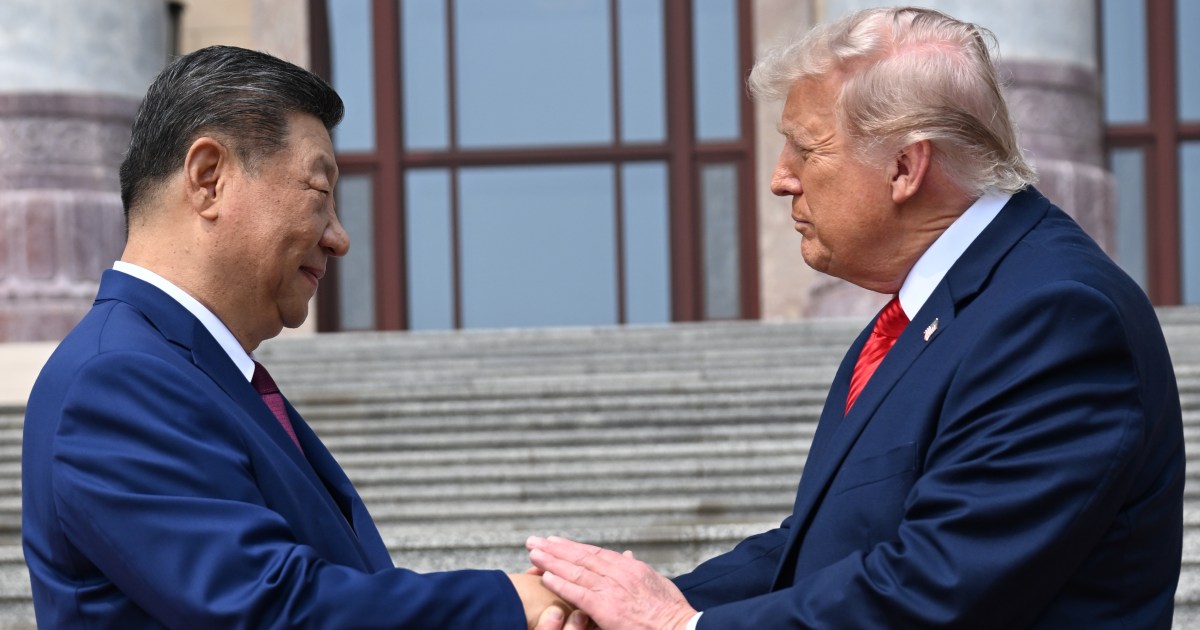
Before arriving for his high-stakes summit with Chinese leader Xi Jinping, United States President Donald Trump aimed to set expectations high.

He said he would urge Xi to “open up” China’s economy and announced a delegation of top business executives, including Tesla’s Elon Musk, Apple’s Tim Cook and Nvidia’s Jensen Huang, to accompany him.

As Trump and Xi prepare to wrap up two days of meetings on Friday, the expectations for their summit’s outcome among observers generally are modest at best.

While Trump and Xi are anticipated to extend the one-year pause in their trade war agreed to in South Korea in October, the expectations are for a stabilisation – not revitalisation – in ties between the world’s two largest economies, which are locked in a rivalry that spans everything from trade and artificial intelligence to the status of Taiwan.

“It is important to be clear-eyed about the state of relations here,” Claire E Reade, a senior counsel at Arnold & Porter who previously worked on China at the Office of the US Trade Representative (USTR), told Al Jazeera.

“China does not trust the US, and China wants to beat the US in what it sees as long-term global competition,” Reade said.

“This limits what can be agreed.”

While Trump and Xi have yet to announce the final contours of any trade agreement, the US side has flagged various business deals in the pipeline.

In a pre-recorded interview with Fox News that aired on Thursday, Trump said that China would invest “hundreds of billions of dollars” in companies run by the CEOs in his delegation, without providing further details.

Trump also said that Beijing had agreed to purchase US oil and 200 Boeing aircraft.

Trump administration officials have said that the sides are also discussing the establishment of a “Board of Investment” to manage investments between the countries.

“A realistic ‘opening up’ of the Chinese market would likely focus first on sectors where the economic complementarity is most obvious,” Taiyi Sun, an associate professor of political science at Christopher Newport University in Newport News, Virginia, told Al Jazeera.

“Agricultural goods such as soybeans and beef, as well as high-value-added manufacturing products like Boeing aircraft, are natural areas for expansion because they match existing Chinese demand with American export strengths.”

Sun said a “gradual” opening for US firms in sectors such as financial services could also be possible.

“But those areas are politically and institutionally more sensitive inside China, so progress would likely be incremental rather than immediate,” he said.

Gabriel Wildau, a senior vice president at global business advisory firm Teneo, said both sides will be seeking to address supply-chain vulnerabilities exposed by their trade war.

“The Iran war has likely increased the US’s vulnerability to export controls on rare earths, given the need to rebuild the munition stocks depleted in that war,” Wildau told Al Jazeera.

“Washington will therefore be willing to offer tariff relief – or at least assurances not to impose new tariffs – in exchange for Beijing’s commitment to keep rare earth exports flowing.”

While Trump and Xi agreed to roll back some trade barriers at their summit in South Korea, US-Chinese business and trade remain severely constrained after a decade of tit-for-tat economic salvoes between the sides.

The average US tariff on Chinese goods stood at 47.5 percent after the South Korea summit, up from 3.1 percent before Trump’s first term, according to the Peterson Institute for International Economics.

China’s average tariff on US goods stood at 31.9 percent, up from 8.4 percent in 2018, according to the think tank.

Two-way goods trade amounted to about $415bn in 2025, down sharply from its 2022 peak of $690bn.

Carsten Holz, an expert on the Chinese economy at the Hong Kong University of Science and Technology, said China has less incentive to make concessions to the US than before, amid the rise of its domestic industries.

“Across many industrial sectors, PRC [People’s Republic of China] firms hold leading or controlling positions,” Holz told Al Jazeera.

“As a result, the PRC economy has little to gain from opening further to the US and is likely to only offer largely symbolic gestures.”

Deborah Elms, head of trade policy at the Hinrich Foundation in Singapore, voiced similar sentiments about the limits of US leverage.

“Basically, Trump expects China to buy more stuff from America and let US companies operate more freely in China,” Elms told Al Jazeera.

“What is he offering?” Elms said. “Very little, largely because Trump sees the bilateral relationship as one where the US has been fair and China has not.”

Reade, the former USTR official, said Xi would not agree to any measures that “harm Chinese interests in any way.”

“Instead, China will potentially give the US no-cost ‘gifts,'” Reade said, suggesting such measures could include the removal of trade barriers it placed on US beef.

“It may buy US goods it needs,” Reade said.

“If it allows purchases of US tech products, it will only be because it needs them right now,” she added, “But this does not interfere with China’s strategic plans to eliminate dependence on US technology over the longer term.”