Press
Orbán era swept away by Péter Magyar's Hungary election landslide
Images
1 / 12

2 / 12
3 / 12
4 / 12
5 / 12
6 / 12
7 / 12
8 / 12
9 / 12
10 / 12
11 / 12
12 / 12
Viktor Orbán's 16 years in power is over, and the system condemned as an "electoral autocracy" lies in tatters, defeated by a 45-year-old former party insider who convinced a majority of Hungarians to bring it to an end.

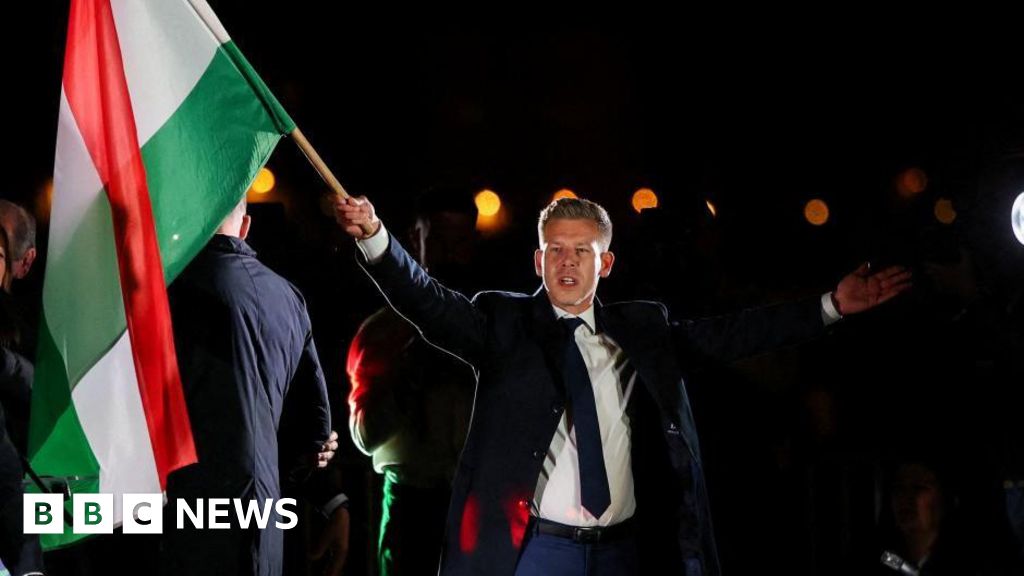
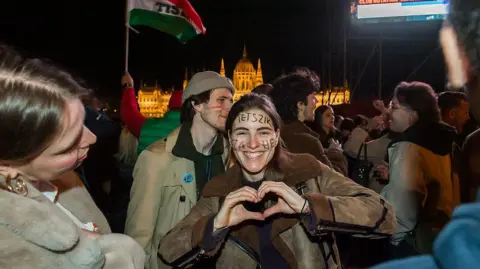
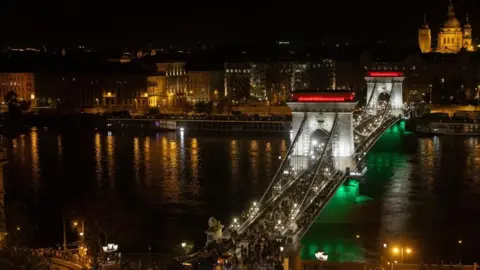
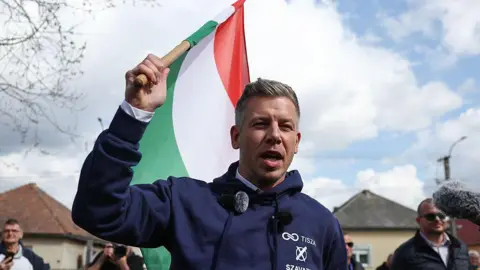
"We did it," Péter Magyar told a crowd of cheering supporters in a square beside the River Danube, overlooking Budapest's magnificent parliament on the other side.

"Together we overthrew the Hungarian regime."

Preliminary election results, based on more than 98% of votes counted, put his Tisza party on course for an extraordinary 138 seats, with Orbán's Fidesz on 55 and the far-right Our Homeland on six.

For two years Magyar took his burgeoning movement around villages, town squares and cities, rallying Hungarians who had had enough of the cronyism and corruption that had become endemic over years.

"Never before in the history of democratic Hungary have so many people voted - and no single party has ever received such a strong mandate," he said on Sunday night, after a record 79.5% of the electorate turned out to vote.

Orbán's rule was built up through four successive election victories and sweeping majorities, but it was over in a matter of minutes.

As pro-Magyar supporters waited expectantly in the square on the Buda side of the Danube, the Tisza leader posted an extraordinary message on Facebook: "Viktor Orbán just called me on the phone and congratulated us on our victory."

There was barely time to digest what had just happened and only 30% of the vote had so far been counted.

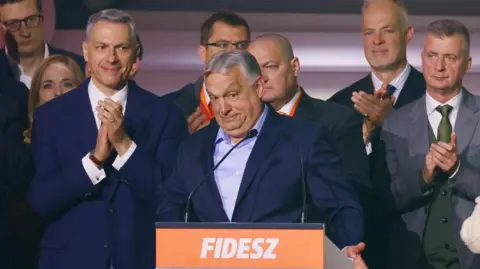
But moments later Orbán himself appeared on a stage in a conference centre a mile down-river on the other side of the Danube, surrounded by his glum-looking Fidesz party colleagues.

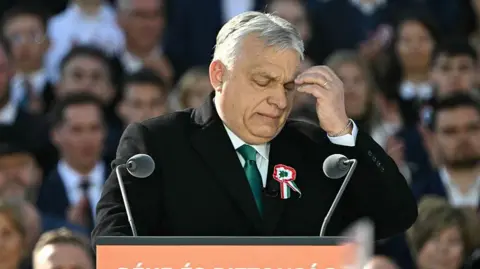
"The result of the election is clear and painful," he told them, thanking the estimated 2.5 million Hungarians who stuck by him. "The days ahead of us are for us to heal our wounds."

Word began to spread among Magyar supporters, and at the nearby hotel that had become party HQ, Tisza activists hugged each other.

Magyar has promised to reverse Orbán-era changes to education and health, tackle corruption, restore the independence of the judiciary and kill off the widely loathed system of patronage known as NER that helped enrich party loyalists and squander state resources.

To make those changes to the constitution, he needed a two-thirds majority of 133 seats, and although the final results are not yet in, latest results suggest Tisza is on course for 138.

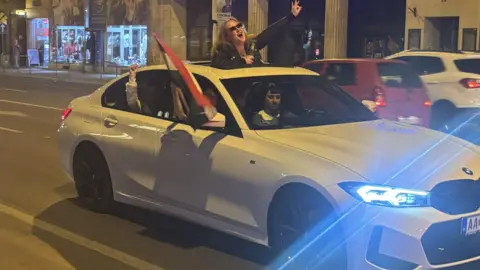
Magyar had been telling his supporters to prepare for a change of regime, and now they had it the parties truly started and the champagne flowed. Cars blared their horns across Budapest, women waving Hungarian flags through open sun roofs.

Many of those who backed Magyar are not natural supporters. For years he backed Orbán and now he has brought him down.

"He's someone you cannot be absolutely sure of," a lawyer called Ágnes told the BBC, "but we're at a point where we need to hope for something better, which he promises - and we truly hope his promises come true."

Another target in Magyar's sights is pro-Orbán state media. The M1 TV channel has until now slavishly toed the party line, along with what were once independent websites bought up over time by Fidesz allies.

Apparently uncertain what to do next, M1 rebroadcast a speech that Magyar had given just after the vote had finished. He had been hopeful of victory at the time, but by now the speech was out of date - he had already won.

Hungary has for some time felt like two different worlds running in tandem. In one, Orbán convinced his supporters and TV viewers they were heading for victory and four more years in power, backed up by opinion polls run by sympathetic pollsters, who continued to forecast a Fidesz victory as late as Sunday evening.

In the other world was Magyar, attracting big crowds wherever he went, backed up by respected pollsters reporting an increasing lead over his rival.

On Sunday night, those two worlds collided, and only one was real.

If Tisza's two-thirds majority is confirmed, state TV is set for change.

Magyar moved slowly through the crowds before taking to the stage, flanked by his party colleagues.

"You performed a miracle today, Hungary made history today," he told the audience, to chants of "Ria-Ria-Hungaria!"

He likened their electoral victory to the Hungarian revolution of 1848, and the uprising against Soviet occupation in 1956.

There was a time when Orbán himself spoke out against Soviet occupation, but he has become a close partner of Russian President Vladimir Putin, and his justification of cheap Russian oil and petrol has made him a highly unpopular leader in the EU, which has tried to shake off its reliance on Russian imports. Orbán has also reneged on an EU agreement to provide Ukraine with a €90bn (£79bn; $105bn) loan.

"Russians go home," Magyar supporters chanted, as the next Hungarian prime minister promised better relations with the European Union.

Poland's Prime Minister Donald Tusk was among the first of many European leaders to welcome Magyar's "glorious victory", adding in Hungarian "Ruszkik Haza" - Russians go home.

The Tisza leader pledged that his first trip abroad as prime minister would be to Warsaw - to reinforce Hungary's 1,000-year friendship with Poland.

He has also promised to travel to Brussels, where he aims to persuade the European Commission to unlock as much as €17bn in funds frozen over failures to tackle corruption and maintain independence in the judiciary.

Magyar has momentum after a marathon campaign that took in up to seven speeches a day and energised big crowds across the country.

His defeated rival sounded tired and jaded in his final campaign speech on Saturday night, as if he knew what was coming.

Orbán, now 62, has not resigned as party leader, and without him it is difficult to imagine what will happen to Fidesz.

For now he will continue to lead Hungary in a caretaker role, while he and his party lick their wounds.

Additional reporting in Budapest by Rita Palfi

Who is the man who brought down Viktor Orbán after 16 years of continuous rule at the head of Hungary's Fidesz party?

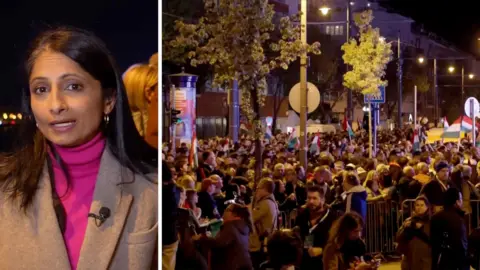
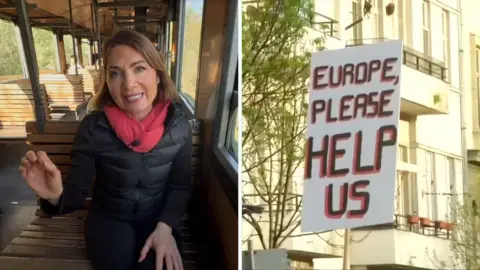
Rajini Vaidyanathan broadcasts from outside Hungary's parliament as crowds hear about the prime minister's concession.

The BBC's Europe Editor Katya Adler reports from Prime Minister Victor Orbán's home town of Felscút.

Since 2010, Orbán has transformed Hungary into what the European Parliament has denounced as a "hybrid regime of electoral autocracy".

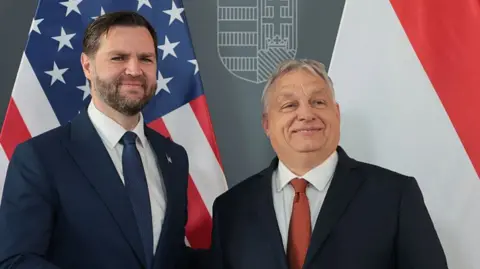
US Vice-President JD Vance intervenes in the campaign to give Orbán a ringing endorsement in Budapest.